2025-2026
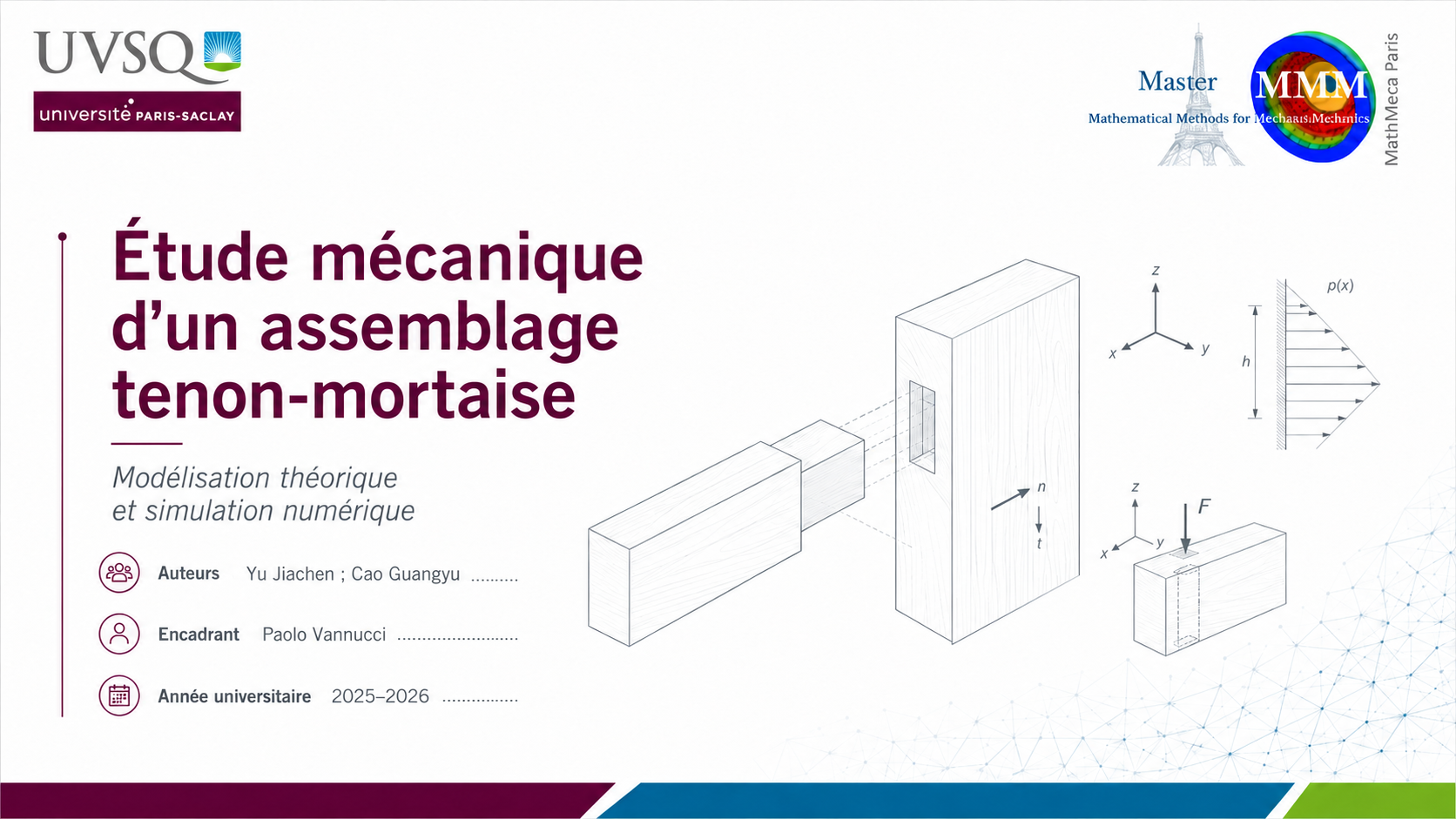
Tenon-Mortise Joint: Modelling and Numerical Analysis
Theoretical and finite element study of a tenon-mortise joint, including Winkler-type support modelling, contact pressure and comparison between analytical and numerical results.
Introduction
A traditional tenon-mortise joint is studied as a mechanical connection whose behaviour can be described through analytical modelling and finite element simulation.
Objectives
Model the joint, study contact pressure, define a finite element workflow in ANSYS and compare theoretical and numerical tendencies without inventing unsupported values.
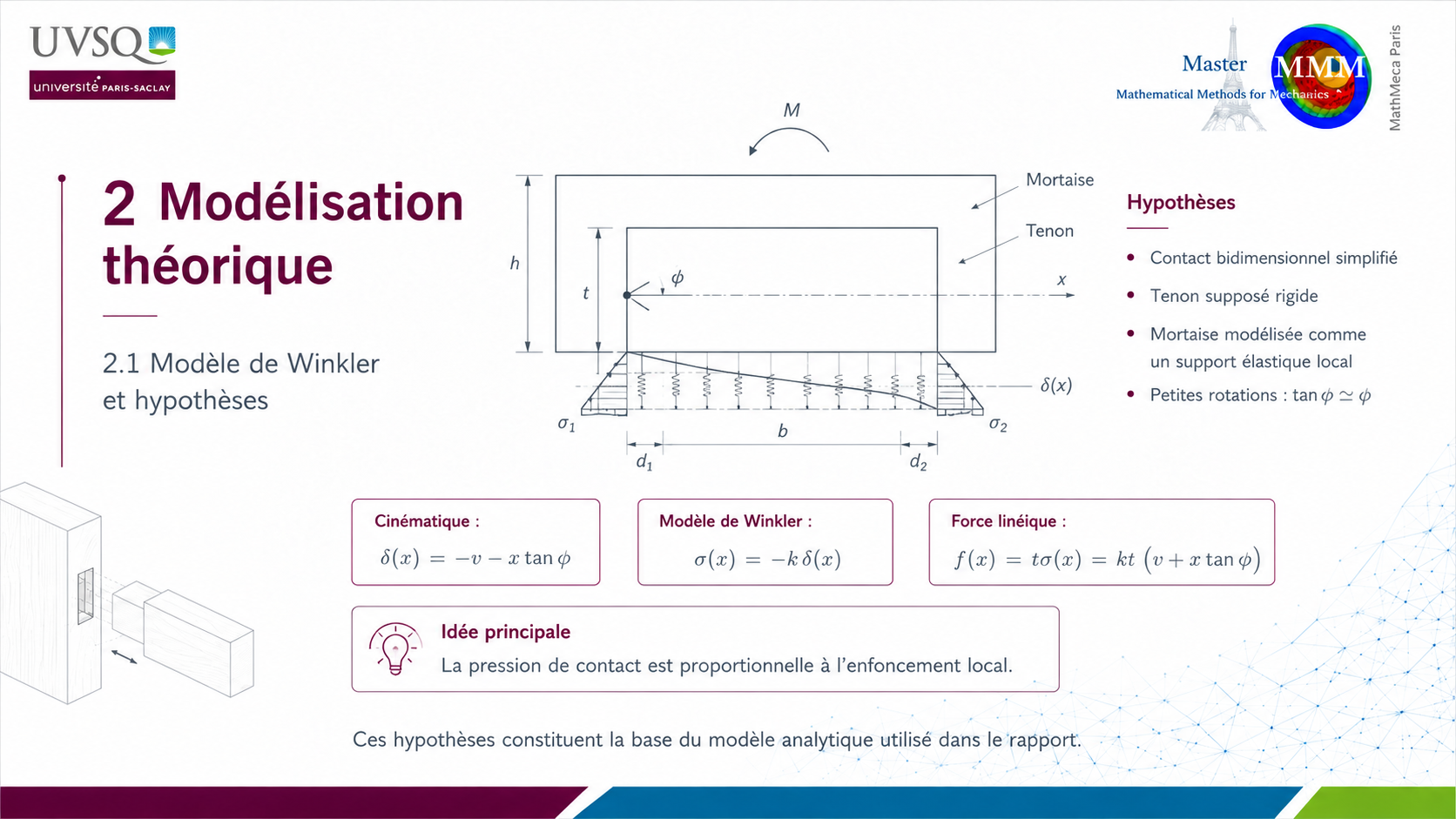
Theoretical Model
The analytical model includes a Winkler-type support representation and contact pressure reasoning.
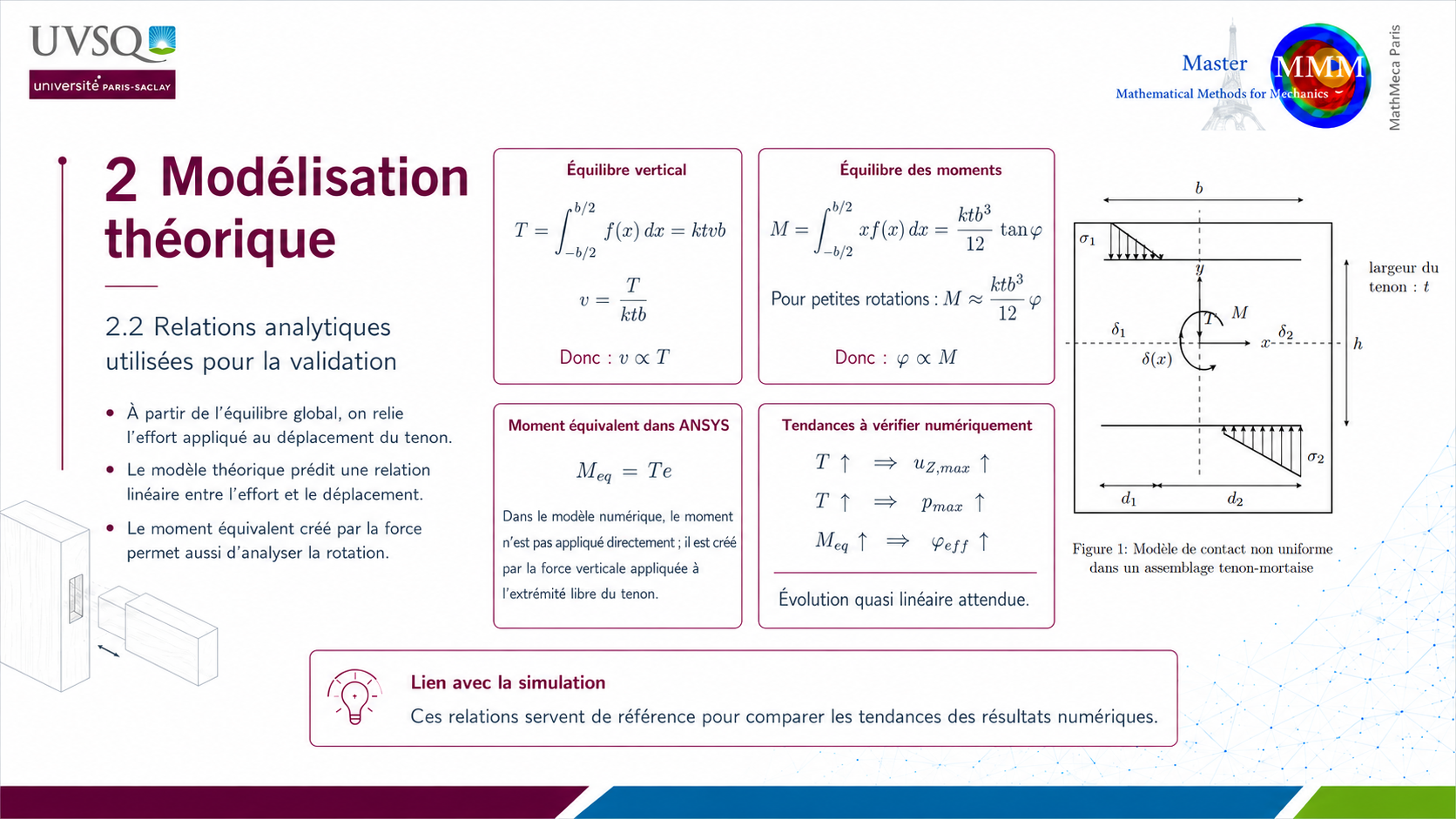
Analytical Framework
The formulation is based on equilibrium relations, support laws and contact pressure expressions used to interpret the joint behaviour.
Finite Element Model
The numerical workflow covers 3D geometry, mesh generation, frictionless contact, loading and boundary conditions.
Results
The analysis focuses on displacement, Von Mises stress, principal stress and contact-pressure distributions from the project report.
Comparison
The theoretical model and finite element results are compared through their mechanical tendencies and contact behaviour.
Conclusion
The project connects classical joint behaviour with a reproducible finite element workflow.
Gallery